
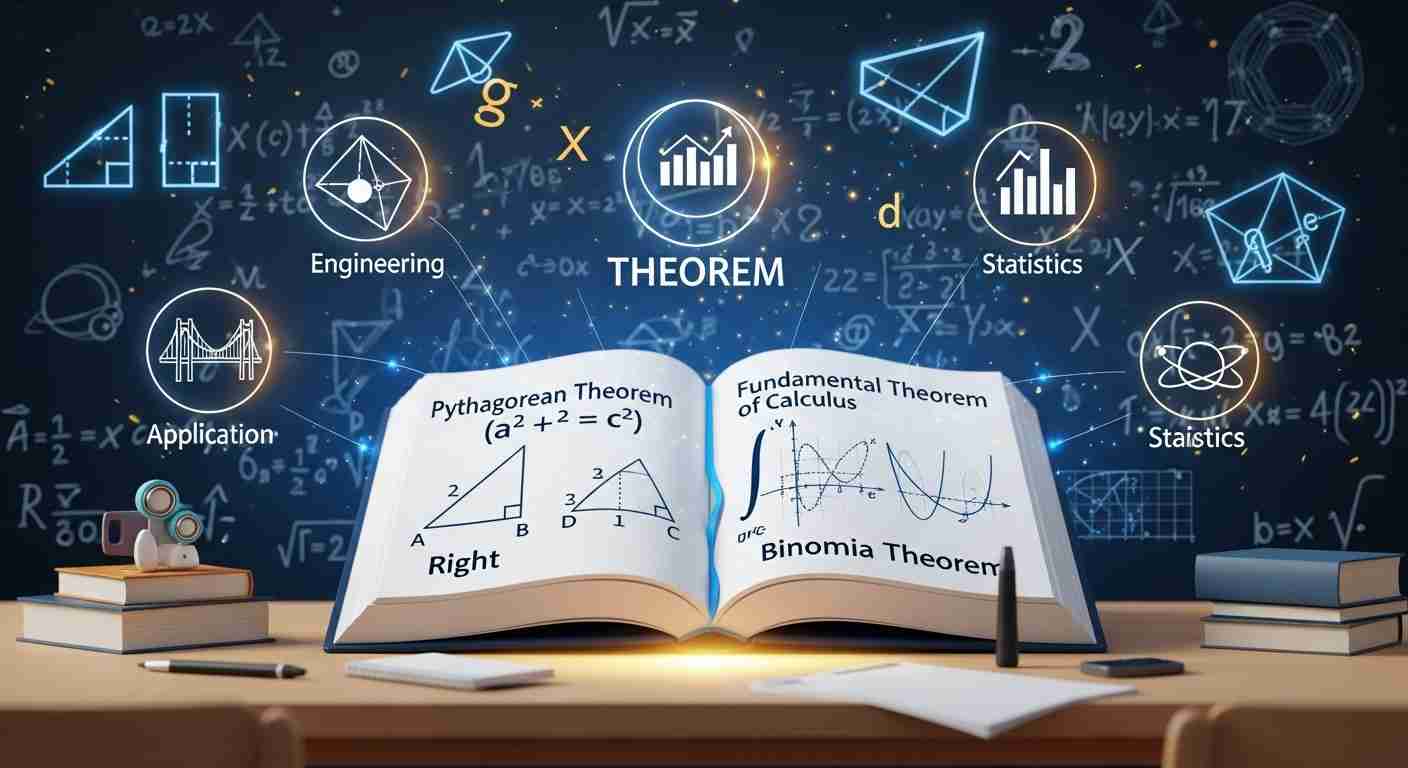
In mathematics, a theorem is more than a rule - it’s a truth proven through logic. Every formula, equation, and law we use stands on the foundation of theorems. They are the verified pillars that connect assumptions (axioms) to real-world results.
Mathematicians use theorems to explain why things work, not just how. Whether it’s predicting the path of a satellite or analyzing financial growth, every precise calculation starts from a proven mathematical statement.
From geometry and algebra to calculus and number theory, theorems bring structure to complexity. Without them, modern science, technology, and engineering would collapse into guesswork.
In simple terms:
A theorem = a statement that has been logically proven to be true.
This article explores what theorems are, how they differ from axioms and postulates, their main types, and how these abstract truths shape real-life innovations - from architecture to artificial intelligence.
A theorem in mathematics is a statement that has been proven true using logical reasoning and established principles. It begins as a hypothesis and becomes a theorem only after being rigorously verified through proofs.
Every theorem follows a structure:
Assumptions (known facts or axioms)
Logical deductions (step-by-step reasoning)
Conclusion (proven truth)
For example, the Pythagorean Theorem connects geometry with algebraic truth:
In a right triangle, a2+b2=c2a^2 + b^2 = c^2.
This relationship holds in every right triangle, regardless of its size or orientation - showing the universality of mathematical truth.
Theorems differ from formulas or equations because they explain why the formula works. Formulas compute; theorems justify.
In essence:
A theorem transforms logical ideas into proven knowledge.
In mathematics, axioms, postulates, and theorems form a logical hierarchy of truth. They may sound similar, but each plays a distinct role in how mathematical systems are built and proven.
An axiom is a fundamental truth accepted without proof. It forms the starting point of mathematical reasoning - a statement so basic that it needs no validation.
Example:
If equals are added to equals, the results are equal.
This principle underlies basic arithmetic and algebraic operations. Axioms are like the rules of the game - everything else in mathematics depends on them.
A postulate is similar to an axiom but applies to a specific field of study, usually geometry or physics-based mathematics. It defines spatial or physical assumptions accepted as true within that context.
Example:
A straight line can be drawn joining any two points. - Euclid’s First Postulate
Postulates help define geometric space, enabling mathematicians to construct shapes, planes, and proofs based on consistent logic.
A theorem is different. It’s not accepted by assumption - it’s proven through logic derived from axioms or postulates.
Example:
The sum of angles in a triangle equals 180°.
This is not assumed; it’s deduced using postulates and reasoning.
| Feature | Axiom | Postulate | Theorem |
|---|---|---|---|
| Definition | Universally accepted truth | Accepted assumption in a specific system | Proven mathematical statement |
| Need for Proof | No | No | Yes |
| Scope | Broad (applies to all math) | Limited (geometry, physics) | Derived result |
| Example | Equals added to equals are equal | A line connects any two points | Sum of angles in a triangle = 180° |
Mathematics contains hundreds of theorems, but they can be grouped into broad categories based on their field of application. Each type focuses on different entities, relationships, and logical principles - from shapes and numbers to functions and limits.
Algebraic theorems explain relationships between numbers, variables, and equations. They form the foundation of problem-solving and symbolic reasoning.
Examples and Key Entities:
Fundamental Theorem of Algebra: Every non-constant polynomial equation has at least one complex root. (Entity: Polynomial → Predicate: has → at least one complex root)
Remainder Theorem: When a polynomial f(x)f(x) is divided by (x−a)(x - a), the remainder equals f(a)f(a).
These theorems make it possible to simplify expressions, predict results, and connect algebraic structures to geometric and analytical systems.
Geometric theorems deal with shapes, space, and the properties of figures. They are visual in nature and often represent the bridge between logic and real-world design.
Examples:
Pythagorean Theorem: In a right triangle, a2+b2=c2a^2 + b^2 = c^2.
Thales’ Theorem: A triangle inscribed in a semicircle is always a right triangle.
Triangle Sum Theorem: The sum of the interior angles of a triangle is always 180°.
Real-world application: These theorems support engineering, architecture, and navigation, where spatial precision is crucial.
Calculus theorems connect algebraic change with continuous motion. They define how quantities vary - the backbone of physics, economics, and machine learning.
Examples:
Fundamental Theorem of Calculus: Differentiation and integration are inverse processes. (Entity: Integration → Predicate: is the inverse of → Differentiation)
Mean Value Theorem: For a continuous function, there exists a point where the instantaneous rate equals the average rate of change.
Practical relevance: These theorems power simulations, motion prediction, and AI optimization models.
Number theory theorems describe properties and relationships of integers. They are central to cryptography, digital security, and pure mathematics.
Examples:
Fermat’s Little Theorem: If pp is a prime number, then ap−aa^p - a is divisible by pp.
Euclid’s Theorem: There are infinitely many prime numbers.
These theorems explain the logic behind prime generation and modular arithmetic - the core of encryption algorithms and blockchain systems.
Mathematical growth has led to new theorem categories:
Topology Theorems: Continuity, connectivity, and shape deformation (e.g., Brouwer Fixed Point Theorem).
Probability Theorems: Laws of likelihood such as Bayes’ Theorem.
Vector Theorems: In physics and engineering (e.g., Green’s, Stokes’, and Gauss’s Theorems).
Each reveals how mathematics connects abstract reasoning with measurable, observable phenomena.
Every theorem in mathematics must be proven before it’s accepted as truth. This verification process is known as a mathematical proof - a structured argument that confirms the validity of a statement using logic and previously established facts.
Proofs are not guesses or opinions. They are logical pathways showing why something must be true, not just why it seems true. There are several kinds of proofs, but the three main methods are direct, indirect, and proof by contradiction.
A direct proof uses logical reasoning to show that one statement leads directly to another. You begin with known facts or axioms and proceed step-by-step until you reach the conclusion.
Example: To prove that the sum of two even numbers is even:
Let even numbers be 2a2a and 2b2b.
Their sum is 2a+2b=2(a+b)2a + 2b = 2(a + b).
Since the result is a multiple of 2, it’s even.
This simple reasoning shows how logical consistency defines truth in mathematics.
An indirect proof (also called proof by contrapositive) works by showing that if the conclusion is false, then the premise must also be false. Instead of proving P → Q directly, you prove ¬Q → ¬P (the contrapositive).
Example: To prove “If a number is divisible by 4, it’s even,” we prove the contrapositive: “If a number is not even, it’s not divisible by 4.” If this is true, then the original statement must also be true.
This form of proof emphasizes logical equivalence - proving a statement by proving its logical mirror.
A proof by contradiction assumes that the opposite of the statement is true - and then demonstrates that this assumption leads to an impossible result. When contradiction occurs, the original statement must be true.
Example: To prove that √2 is irrational:
Assume √2 is rational (can be written as p/q in lowest terms).
Then 2=p2/q22 = p^2/q^2 → p2=2q2p^2 = 2q^2.
This implies both p and q are even - contradicting the assumption of lowest terms.
Hence, √2 is irrational.
Proofs ensure that mathematical theorems are reliable, consistent, and universal. They protect logic from error and prevent false assumptions from spreading through scientific models.
In fields like physics, computer science, and artificial intelligence, proofs form the basis of algorithms, models, and predictions. Without proofs, math would collapse into uncertainty - a collection of unverified claims.
Mathematical theorems aren’t just abstract symbols on paper - they are the logical backbone of real-world systems. Every bridge, spacecraft, circuit, or AI model you see exists because of theorems that translate pure logic into physical reliability.
In engineering, theorems guide the design, stability, and efficiency of structures. For example, the Pythagorean Theorem allows engineers to calculate precise distances and load distributions, while trigonometric theorems enable accurate measurements in construction and mechanical design.
In civil engineering, theorems of geometry and algebra ensure that bridges, buildings, and tunnels maintain balance, symmetry, and durability. Without them, structural safety would be pure guesswork.
Physics is built on theorems that define motion, energy, and relationships between forces. For instance, the Fundamental Theorem of Calculus links velocity and displacement, letting physicists model acceleration and gravity with precision.
Similarly, Gauss’s Divergence Theorem helps analyze electric and magnetic fields - a cornerstone of modern electromagnetism and field theory.
These theorems give scientists the mathematical tools to predict natural behavior, from the orbit of planets to the flow of fluids.
In computer science, theorems define how algorithms operate, how encryption secures data, and how AI learns patterns. For example, Number Theory Theorems such as Fermat’s Little Theorem and Euclid’s Theorem form the basis of cryptography, ensuring data integrity and digital privacy.
Meanwhile, calculus and linear algebra theorems drive machine learning models - optimizing neural networks, adjusting weights, and minimizing errors during training. Every AI decision, from recognizing an image to predicting stock prices, relies on theorem-based computation.
In economics, theorems help model optimization and equilibrium. For example, the Mean Value Theorem and Optimization Theorems are used to find maximum profit or minimum cost in business models. In data science, mathematical proofs support regression analysis, clustering, and probability modeling. They ensure that predictions are mathematically valid, not random assumptions.
Even daily life reflects theorem-based logic - from calculating home loan interest (algebraic theorems) to predicting travel time (geometric and calculus-based reasoning). Your phone’s GPS, video compression, and secure messaging apps all rely on theorems transformed into algorithms.
Mathematics stands on a few great pillars - theorems that redefined how we understand space, logic, and reality. These timeless proofs didn’t just shape math; they built physics, computer science, architecture, and AI. Below are ten of the most influential mathematical theorems that continue to power the modern world.
Perhaps the most famous theorem in history, the Pythagorean Theorem bridges geometry and algebra. It explains the precise relationship between the sides of a right triangle and underpins countless applications - from architecture and navigation to 3D modeling and GPS technology.
Formula:
a2+b2=c2a^2 + b^2 = c^2
Meaning: The square of the hypotenuse equals the sum of the squares of the other two sides.
Real-life applications: Civil engineering, CAD design, computer graphics, trigonometric modeling, and physics simulations.
This theorem ensures that every polynomial equation has at least one complex root. It’s the bridge between real numbers and complex analysis - ensuring that algebraic equations can always be solved in the complex domain, even when they seem unsolvable in real numbers.
Every non-constant single-variable polynomial has at least one complex root.
Applications: Quantum mechanics, signal processing, complex analysis, and polynomial equation solvers.
The Fundamental Theorem of Calculus connects differentiation and integration - the two core operations in calculus. It proves that differentiation and integration are inverse processes, forming the foundation for motion analysis, optimization, and continuous modeling.
If F′(x)=f(x)F'(x) = f(x), then
∫abf(x) dx=F(b)−F(a)\int_a^b f(x)\,dx = F(b) - F(a)
Applications: Physics, economics, fluid dynamics, and any system involving change over time.
The Binomial Theorem provides a systematic way to expand powers of binomials like (a+b)n(a + b)^n. It’s a cornerstone in combinatorics and probability, revealing deep patterns in algebraic expansions and forming the mathematical backbone of Pascal’s Triangle.
(a+b)n=∑k=0n(nk)an−kbk(a + b)^n = \sum_{k=0}^{n} \binom{n}{k} a^{n-k} b^k
Applications: Probability theory, statistics, algorithm design, and financial modeling.
Once considered impossible to prove, Fermat’s Last Theorem haunted mathematicians for over 350 years. It states that no three positive integers a,b,ca, b, c can satisfy the equation an+bn=cna^n + b^n = c^n for any integer value of n>2n > 2.
No positive integers a,b,ca, b, c satisfy an+bn=cna^n + b^n = c^n for n>2n > 2.
Applications: Number theory, cryptography, and mathematical logic.
Gödel shattered the idea of complete mathematical certainty. His two theorems show that any sufficiently complex mathematical system contains true statements that can’t be proven within the system itself. This redefined the philosophy of mathematics and logic forever.
No consistent formal system can be both complete and provable within its own framework.
Applications: Artificial intelligence, logic theory, computational limits, and philosophy of mathematics.
Euclid proved that there are infinitely many prime numbers - the building blocks of arithmetic. His elegant proof remains one of the earliest and most enduring in mathematical history.
There is no largest prime number; primes continue infinitely.
Applications: Cryptography, digital security, coding theory, and computational mathematics.
Taylor’s Theorem shows how any smooth function can be approximated by a polynomial. This powerful concept allows scientists and engineers to model nonlinear systems with simple equations - from predicting planetary motion to analyzing machine learning functions.
f(x)=f(a)+f′(a)(x−a)+f′′(a)2!(x−a)2+…f(x) = f(a) + f'(a)(x-a) + \frac{f''(a)}{2!}(x-a)^2 + \dots
Applications: Engineering, physics, data science, and numerical analysis.
Green’s Theorem connects the line integral around a simple closed curve with the double integral over the region it encloses. It’s a fundamental theorem in vector calculus, essential for understanding fluid flow, electromagnetism, and energy fields.
∮C(L dx+M dy)=∬R(∂M∂x−∂L∂y)dx dy\oint_C (L\,dx + M\,dy) = \iint_R \left(\frac{\partial M}{\partial x} - \frac{\partial L}{\partial y}\right) dx\,dy
Applications: Fluid dynamics, electromagnetism, and differential equations.
The Central Limit Theorem (CLT) is the backbone of statistics. It states that the sum of many independent random variables tends toward a normal distribution - even if the original data isn’t normal. This theorem explains why the bell curve appears everywhere in nature and data science.
The distribution of sample means approximates a normal distribution as the sample size grows, regardless of the original population’s distribution.
Applications: Probability, finance, data analytics, and machine learning.